
Network Animations: Knowledge Transfer Simulations of Margaret Cavendish and the Royal Society
These animations were produced by Todd Linkner based on the findings of research completed by Brian Ball, Tyler Gore, Marta Weber, and Peter West at Northeastern University London as part of the TIER 1 funded project New Digital Methods for Understanding the Impacts of Early Women Writers on Science and Philosophy (supported by the NULab, the Women Writers Project, and the Center for Design).
As part of this project, the team in London employed network analysis and computer network simulations to evaluate the status of women in early modern intellectual networks. Specifically, the team focused on the relationship between Margaret Cavendish (1623–1673) and the founding members of the Royal Society. The primary database for this research was the Six Degrees of Francis Bacon project. Six Degrees of Francis Bacon is a digital reconstruction of a network consisting of 13,309 ‘nodes’ (i.e., historical figures) and the ‘edges’ that connect them to one another. In turn, the information about these nodes and the edges between them is drawn from the Oxford Dictionary of National Biography. For reference, the founding members of the Royal Society (as represented in the SDFB dataset) were William Brouncker (c.1620–1684), Robert Boyle (1627–1691), Robert Hooke (1635–1703), Henry Oldenburg (c.1618–1677), William Petty (1623–1687), John Wilkins (1614–1672), Christopher Wren (1632–1723), and Prince Rupert of the Rhine (1619–1682).
The first three animations represent the findings of simulations carried out on on three networks:
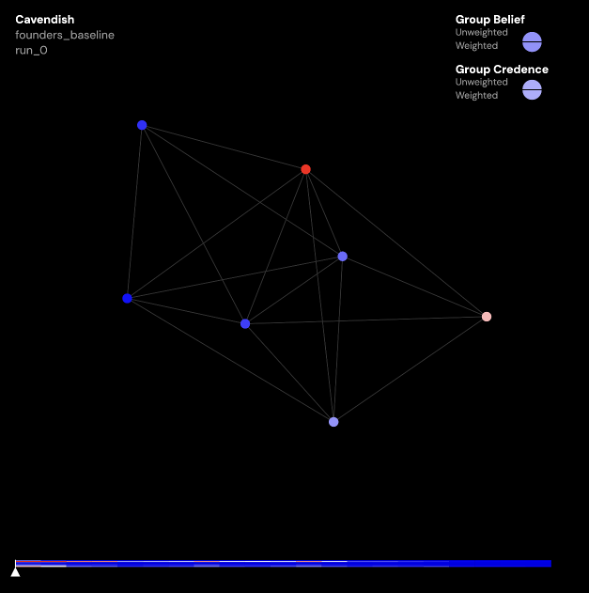
- A network consisting of the (connected) founding members of the Royal Society. (Note that Prince Rupert of the Rhine, who does appear in networks (2) and (3), does not appear in this network as he does not share any edges with other founding members in the Six Degrees of Francis Bacon network.)
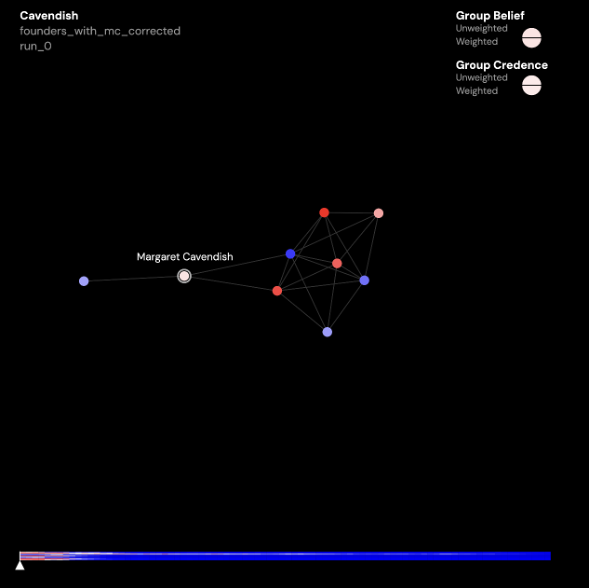
- A network consisting of the founding members of the Royal Society plus Cavendish who retains her ‘real’ connections to those RS founding members, i.e., her connections as represented in the Six Degrees of Francis Bacon dataset.
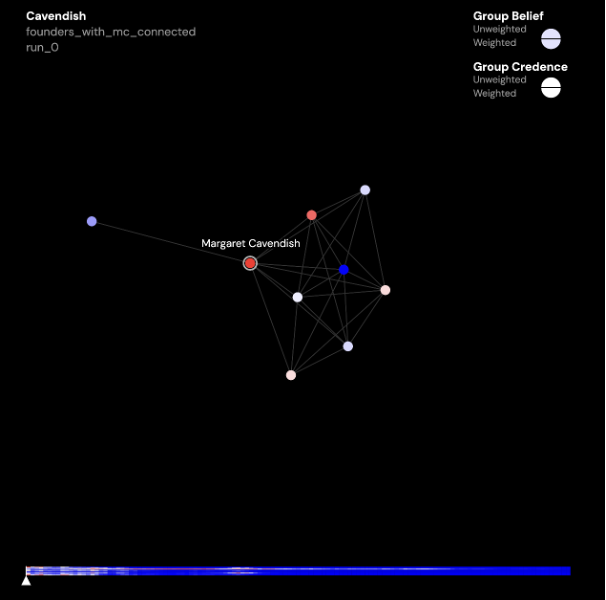
- A network consisting of the founding members of the Royal Society plus a super connected Cavendish, i.e., version of Cavendish who is connected to every RS founding member.
For detailed analysis of the findings of these simulations, see Networks Analysis and Knowledge Transfer Simulations: Six Degrees of Francis Bacon and this exhibit on Computer Network Simulations and Early Modern Intellectual Networks: The Case of Margaret Cavendish and the Royal Society.
Animation screenshots and links: Margaret Cavendish and the founding members of the Royal Society
Note that below we have included static screenshots of the networks prior to the commencement of the animation. The animations themselves can be found (and interacted with) by following the relevant links. Note also that for each animation three types of layout are available (spring, circle, community); for the static images below, we have used the ‘spring’ layout.
Animation 1: Royal Society founding members
Link to Animation 1.
This animation depicts the simulated transfer of knowledge between members of network (1): the founding members of the Royal Society (minus Prince Rupert of the Rhine). Thus, while the knowledge transfer here is simulated, it is a simulation involving a ‘real’ network (real, that is, as represented in the SDFB dataset). Once the animation commences (when you click ‘Play’), the bar below the network visualisation begins to gradually turn blue, representing an emerging consensus as to the group’s belief in a given (idealised) hypothesis.
Animation 2: Royal Society founding members plus ‘real’ Cavendish
Link to Animation 2.
This animation depicts the simulated transfer of knowledge between members of network (2): the founding members of the RS plus Cavendish with her ‘real’ connections. In the static image above, for example, you can see a node labelled ‘Margaret Cavendish’ that shares an edge with three other nodes. One of those nodes is Prince Rupert of the Rhine who only Cavendish shares an edge with—hence, his absence from network (1). Readers may be able to guess, just from looking at this static image, which node is Rupert—but can follow the link and hover over each node to find out. As the animation commences, we again see the group gradually arrive at a consensus with regard to the hypothesis in question.
Animation 3: Royal Society founding members plus super Cavendish
Link to Animation 3.
This animation depicts the simulated transfer of knowledge within network (3): a version of the RS founding members network that includes a super-connected Cavendish, i.e., a version of Cavendish that shares an edge with all of the other members. In the simulations involving this network, where Cavendish is connected to all other nodes, she holds the highest average belief and is the first one to reach the truth.
Animation screenshots and links: Margaret Cavendish and the full Royal Society
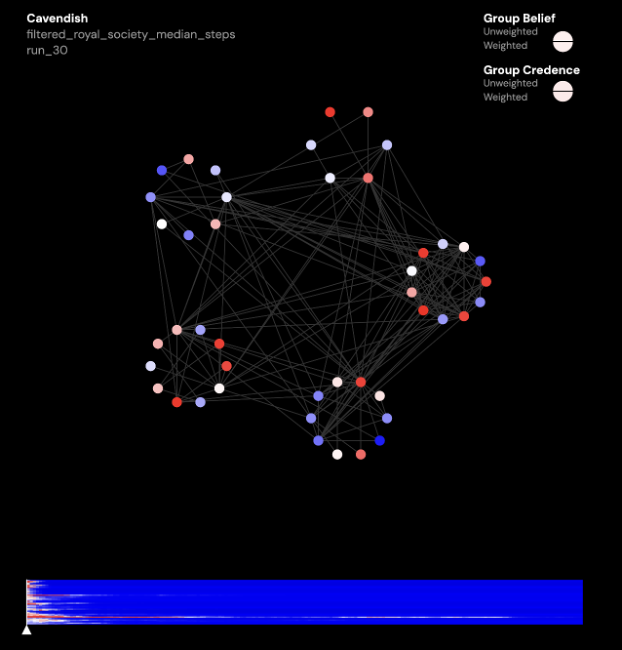
Todd also generated animations of knowledge transfer simulations involving not just the founding members of the RS but all the members of the RS (as represented in the Six Degrees of Francis Bacon dataset). As above, we carried out simulations on counter-factual versions of this much larger network, adding both a ‘real’ version of Cavendish to the network and a super-connected Cavendish to the network. The static images below, with links to the relevant animations, thus correspond to the following networks:- A network consisting of members of the Royal Society
- A network consisting of members of the Royal Society plus Cavendish with her ‘real’ connections.
- A network consisting of members of the Royal Society plus Cavendish, where Cavendish is connected to all other members.
Note that for the following static visualisations, we have used the ‘communities’ layout (but readers can again toggle between communities, spring, and circle).
Animation 4: Full Royal Society network
Link to Animation 4.
This animation depicts the simulated transfer of knowledge across all members of the Royal Society (as represented in the SDFB dataset). As the simulation proceeds, one can see that most nodes turn blue—indicating a high credence level—fairly quickly. Some, however, take a considerably longer time; in particular, those in the top-most community or subgroup (in the image above). John Vaughan, who only shares an edge with one other node, takes by far the longest to reach a high credence level.
Animation 5: Full Royal Society network plus ‘real’ Cavendish
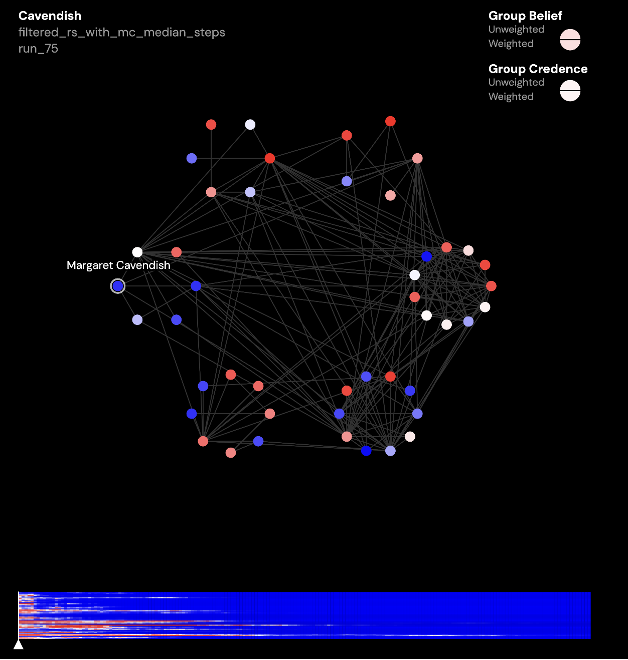
Link to Animation 5.
In this animation, where Cavendish is added to the network but retains her ‘real’ edges, she is—relative to certain other nodes in the network—fairly quick to develop a high credence level. Other nodes, including Alexander Bruce and Sir Robert Moray (who are in the same community as John Vaughan) are much slower to do so. This is likely down to the fact that even when she retains her ‘real’ edges, Cavendish shares edges with more other nodes than these individuals. Interestingly, in this animation, more nodes take a higher number of steps to reach a high credence level than in the previous animation.
Animation 6: Full Royal Society network plus super Cavendish
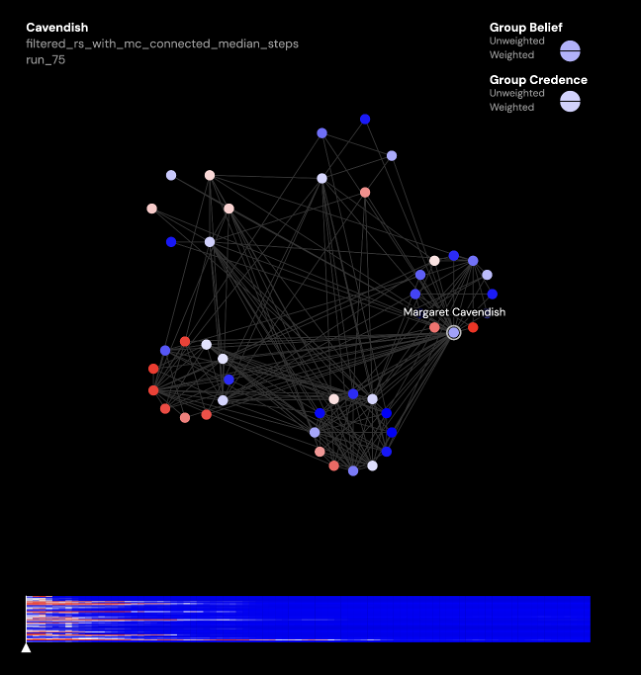
Link to Animation 6.
This animation depicts the full Royal Society network plus a super-connected Cavendish. One thing to note is that the subgroup or community at the bottom-most of the static image above—a group that includes figures such as Robert Boyle, Sir Christopher Wren, and Kenelm Digby—is the quickest to reach, within the subgroup, a unanimous consensus in terms of their credence level in the hypothesis. Meanwhile, Antonio Conti, who is part of Cavendish’s own subgroup, is the last node to reach a high credence level.
